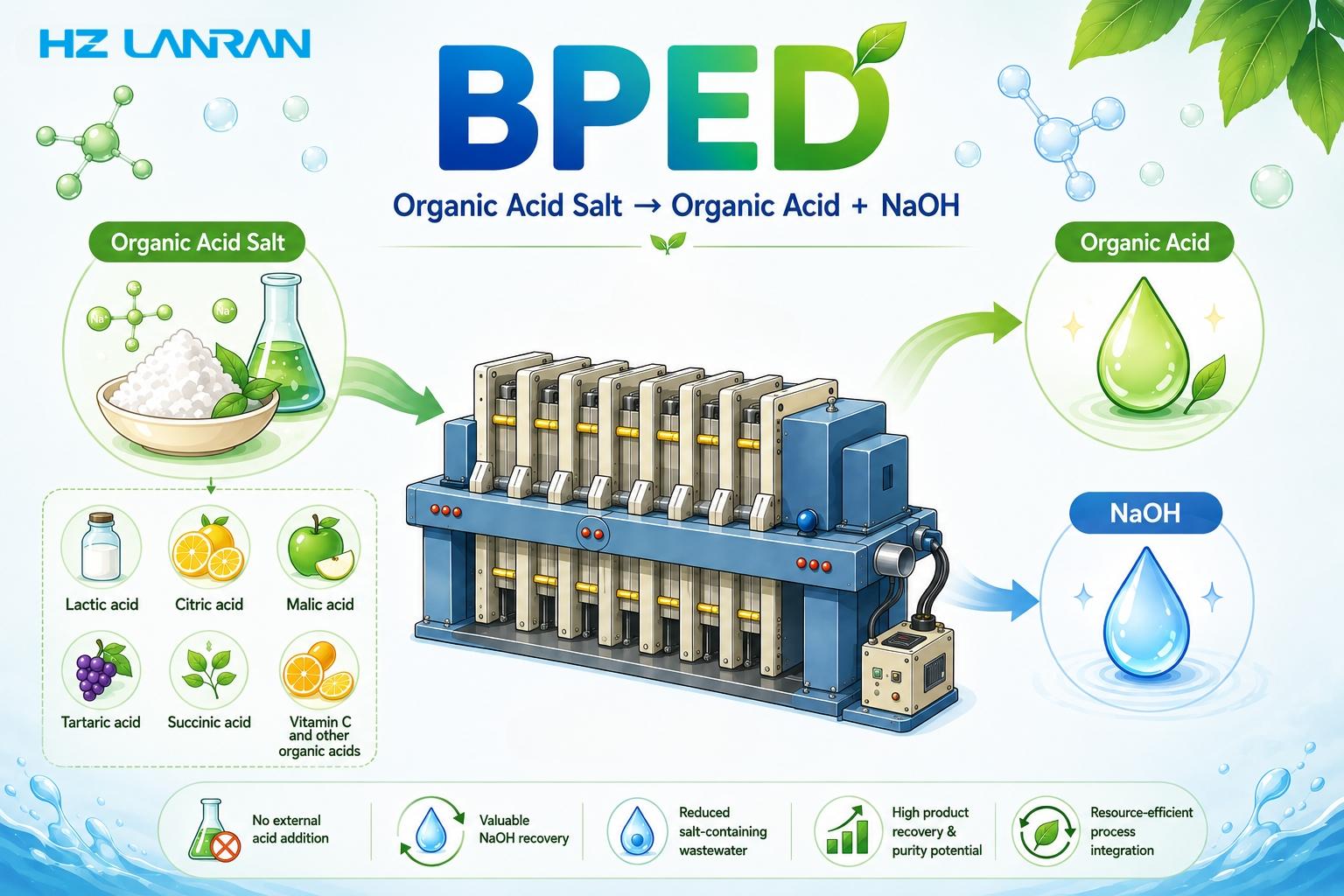
From Organic Acid Salts to Organic Acids with BPED
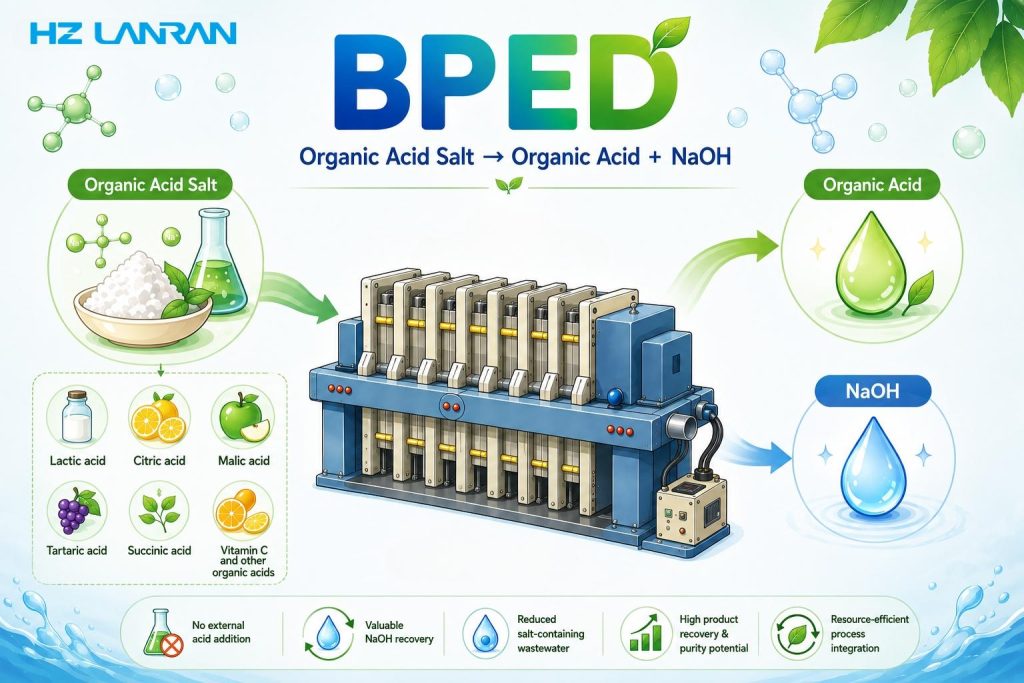
In fermentation, biochemical, and pharmaceutical processes, organic acids are often recovered or neutralized as sodium salts.
Converting these salts back into free organic acids traditionally requires external acids, which can introduce additional salts and increase downstream treatment requirements.
Bipolar Membrane Electrodialysis (BPED) offers an alternative.
Under an electric field, the bipolar membrane generates H⁺ and OH⁻ through water dissociation. H⁺ converts the organic acid salt into the corresponding free organic acid, while OH⁻ combines with Na⁺ to produce NaOH.
Overall conversion:
RCOONa + H₂O → RCOOH + NaOH
Why BPED?
✓ Free organic acid recovery
✓ Simultaneous NaOH production
✓ No external acid required for the conversion step
✓ Reduced introduction of additional inorganic salts
✓ Continuous membrane-based operation
✓ Potential for resource recovery and process integration
Potential applications include lactic acid, malic acid, succinic acid, tartaric acid, and other organic acid salts.
Instead of treating organic acid salts as low-value streams, BPED creates an opportunity to recover valuable chemicals and improve resource utilization.
If you are handling organic acid salts in fermentation, food, pharmaceutical, or biochemical processes, LANRAN can help evaluate the feasibility of BPED-based conversion.