From Battery Black Mass to Battery-Grade LiOH·H₂O: How BPED Supports Lithium Recycling
As demand for lithium-ion batteries grows, the recycling industry faces a growing need to recover lithium efficiently. However, traditional recovery routes can require large amounts of chemicals. They may also involve several processing steps and generate solid waste.
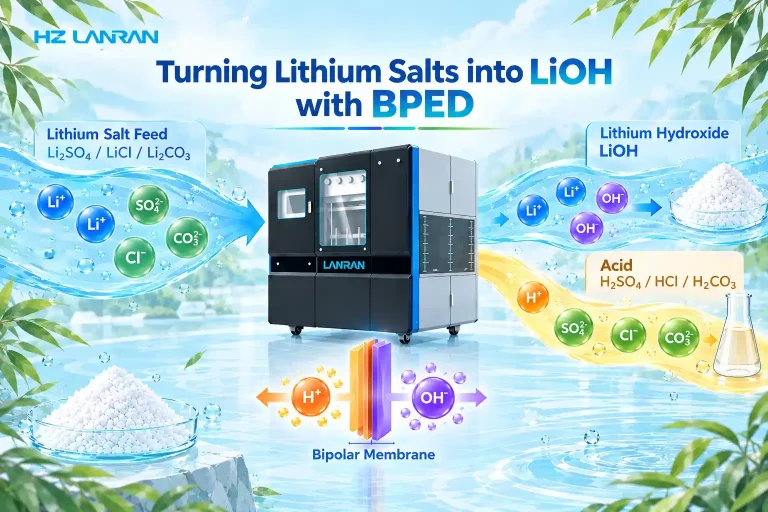
Bipolar Membrane Electrodialysis (BPED) offers another way to process lithium salts from battery recycling. LANRAN’s BPED technology converts lithium sulfate solutions into lithium hydroxide and sulfuric acid. This approach also creates opportunities for chemical reuse and more efficient resource recovery.
What Is Battery Black Mass?
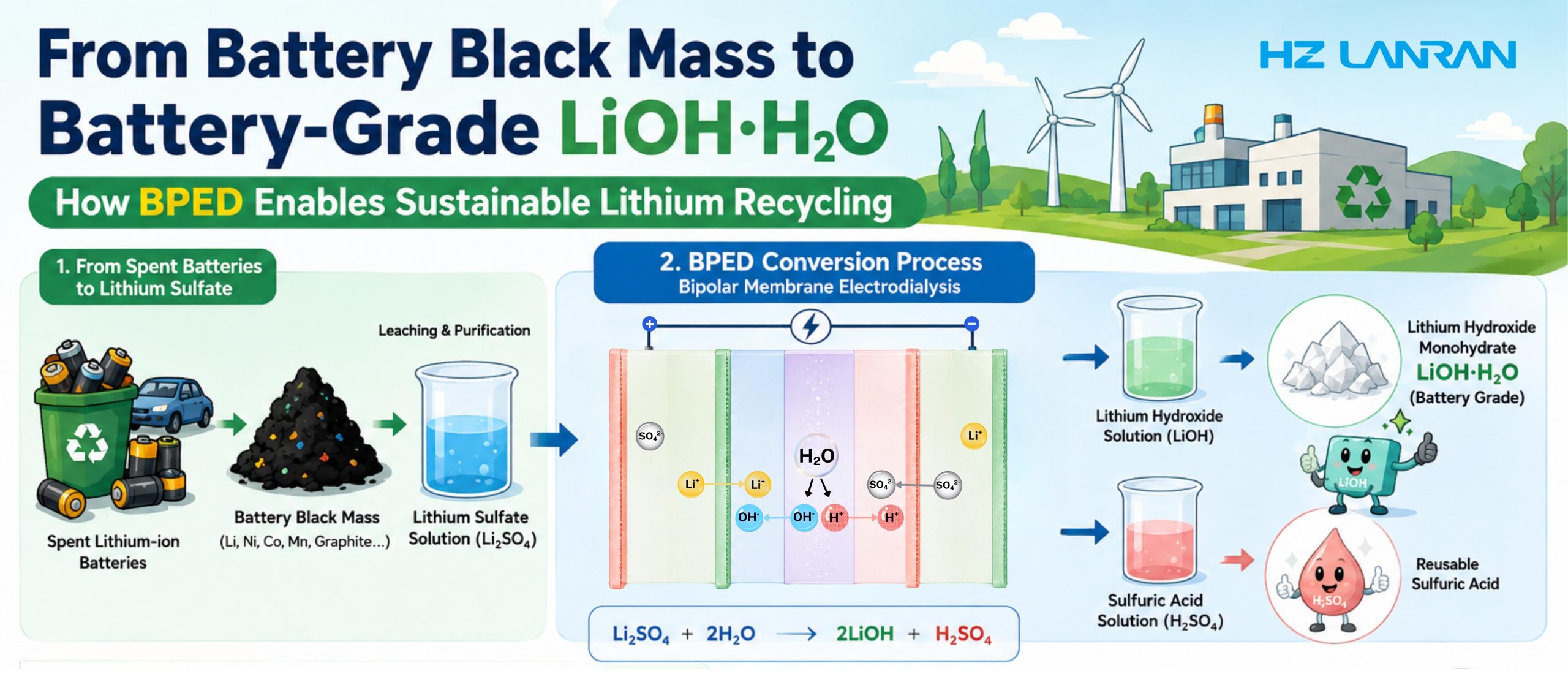
Battery black mass is a powder recovered from spent lithium-ion batteries after dismantling and pretreatment. It typically contains lithium, nickel, cobalt, manganese, graphite, and other battery materials.
During hydrometallurgical recycling, manufacturers leach lithium from black mass into a solution. They can then recover the lithium as lithium sulfate (Li₂SO₄).
The next step is to convert this lithium salt into lithium hydroxide monohydrate (LiOH·H₂O). Battery manufacturers use this compound as a key raw material for producing high-nickel cathode materials.
How BPED Converts Lithium Sulfate into Lithium Hydroxide
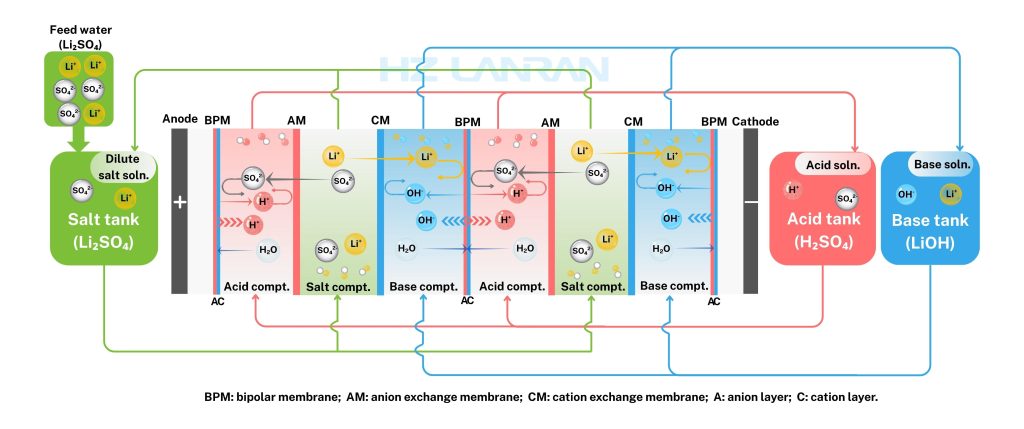
BPED combines bipolar membranes, cation exchange membranes, and an electric field to drive ion transport and chemical conversion.
Inside the bipolar membrane, water dissociates into hydrogen ions (H⁺) and hydroxide ions (OH⁻). These ions then support acid and alkali production within the membrane stack.
During operation, the system carries out three key functions:
- Lithium transport: Lithium ions (Li⁺) pass through cation exchange membranes into the base compartment.
- Lithium hydroxide production: Hydroxide ions (OH⁻) combine with lithium ions to form lithium hydroxide (LiOH).
- Sulfuric acid production: Hydrogen ions (H⁺) combine with sulfate ions in the acid compartment to form sulfuric acid (H₂SO₄).
The overall reaction is:
Li₂SO₄ + 2H₂O → 2LiOH + H₂SO₄
As a result, BPED converts lithium sulfate into lithium hydroxide solution while producing sulfuric acid. Manufacturers may reuse the recovered acid in suitable process steps.
The lithium hydroxide solution can then undergo concentration and crystallization. Further purification may also be needed to meet battery-grade specifications.
Key Benefits of BPED for Lithium Battery Recycling
1. Reduced Chemical Requirements
Conventional conversion routes may use sodium hydroxide or lime. In contrast, BPED uses electricity to drive ion transport and water dissociation.
This approach can reduce the need for external conversion chemicals. Actual chemical savings depend on the process design and operating conditions.
2. Reduced Gypsum Generation
Some conventional lithium hydroxide production routes generate gypsum during chemical conversion. BPED offers an alternative that avoids this gypsum-forming conversion step.
Consequently, the process can reduce the related solid waste handling and treatment requirements.
3. Acid and Alkali Production in One Process
BPED produces lithium hydroxide and sulfuric acid from lithium sulfate solution. In addition, manufacturers may return the recovered acid to suitable upstream processes.
This integration creates opportunities to improve chemical use and reduce fresh chemical demand.
4. Better Lithium Resource Utilization
BPED converts lithium sulfate into a valuable lithium hydroxide solution. When manufacturers integrate the technology with suitable upstream and downstream processes, they can improve resource utilization across the recycling chain.
5. Potential for Lower-Carbon Processing
BPED uses electricity to drive chemical conversion. Manufacturers can also use lower-carbon electricity to help reduce process emissions.
However, the overall carbon benefit depends on the electricity source, energy consumption, and performance of the wider recycling process.
LANRAN’s Industrial Experience in Lithium Recovery
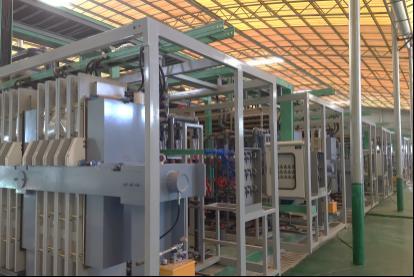
LANRAN combines ion exchange membrane manufacturing, BPED technology, and industrial electrodialysis equipment to support lithium resource recovery.
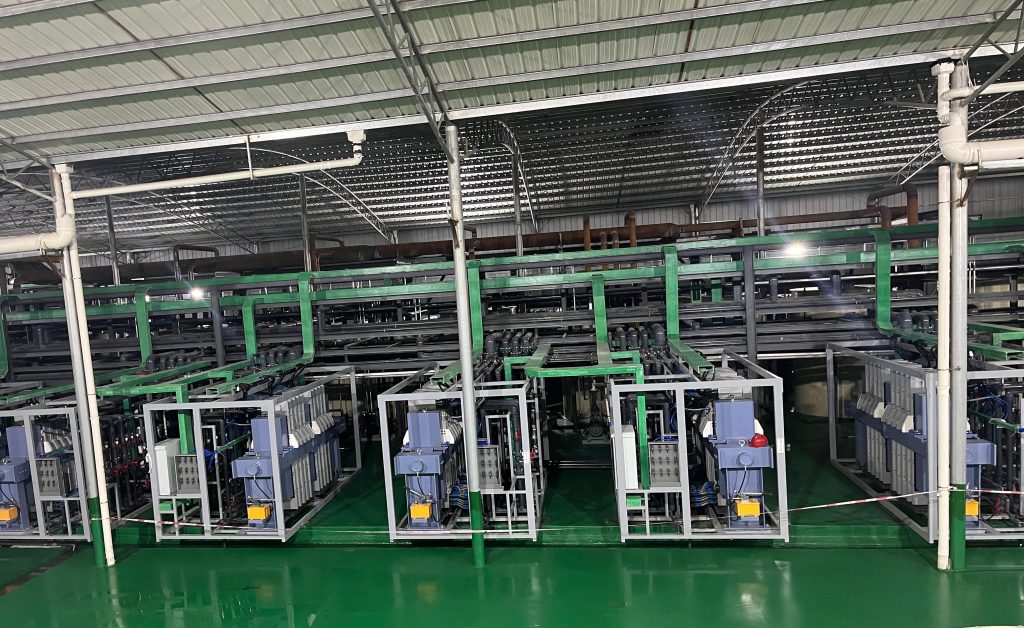
For example, a lithium hydroxide monohydrate production plant in Jiangxi Province, China, has a production capacity of 12,500 tonnes per year. The facility has operated commercially since 2021.
The plant uses LANRAN’s BPED technology to convert lithium sulfate into lithium hydroxide and sulfuric acid. This project demonstrates the industrial application of membrane-based chemical conversion in lithium production.
LANRAN’s membrane and electrodialysis solutions also support several related applications:
- Converting lithium sulfate into lithium hydroxide
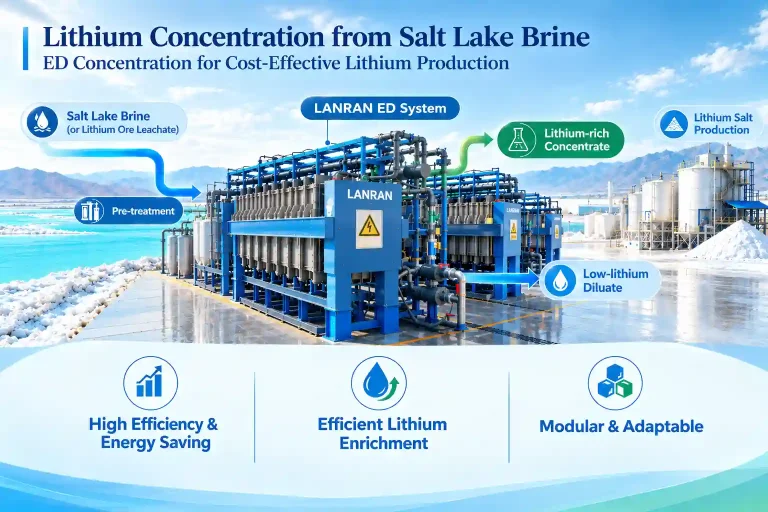
- Recovering and concentrating lithium from process solutions
- Treating battery black mass leachates
- Recovering resources from battery manufacturing wastewater
- Converting sodium sulfate into value-added acid and alkali products
Supporting More Efficient Lithium Recycling
Lithium recycling requires effective recovery methods and careful integration of each process step. BPED provides an option for converting lithium sulfate into lithium hydroxide while generating sulfuric acid for potential reuse.
Through its membrane technology and industrial electrodialysis solutions, LANRAN helps customers explore more efficient lithium recovery processes. These solutions support better resource utilization and the development of more sustainable battery material supply chains.